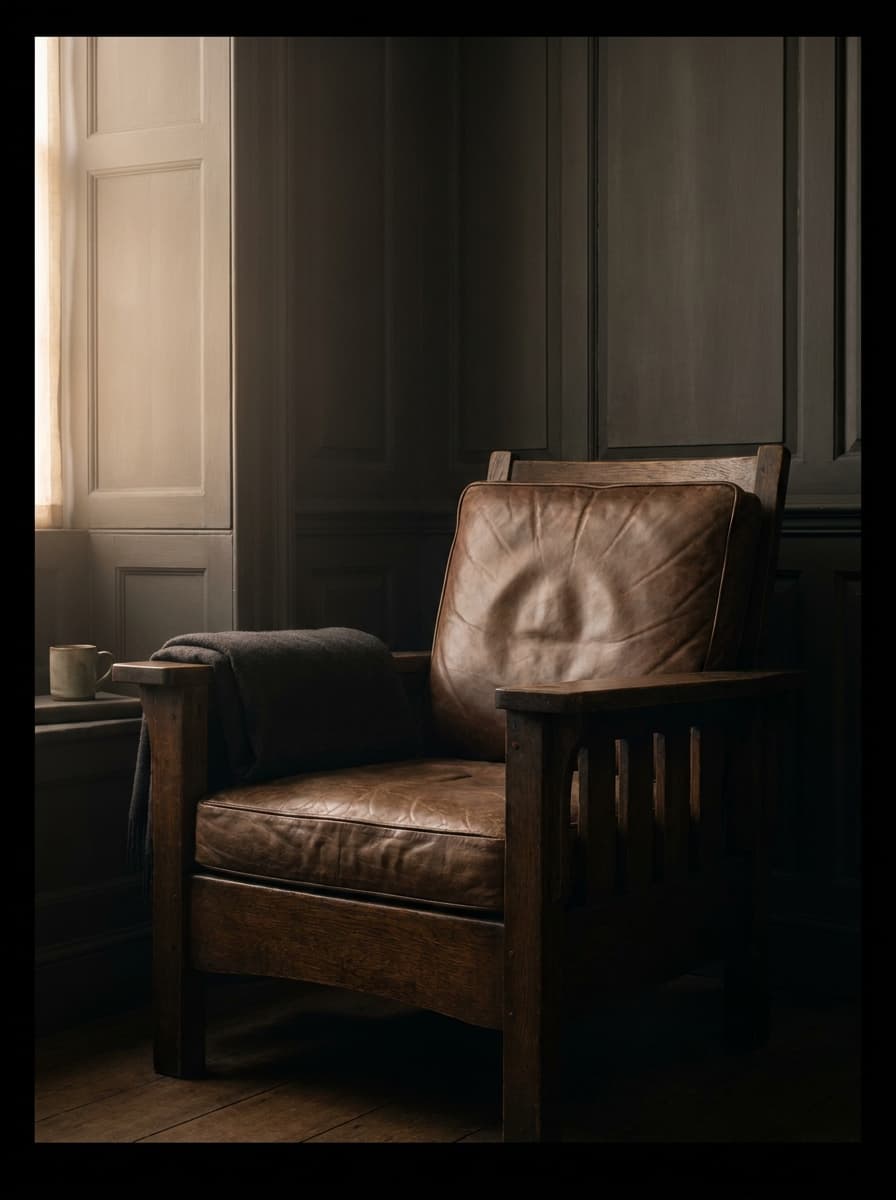
The Dedication
The Dedication
For the man who taught me what patience looks like in a glass.
There are things you understand immediately and things you understand only after they are gone. My father's relationship with cognac was the second kind.
I · The Ritual
After dinner. Every time. Without exception.
He had a ritual. Not performed — practised. Every evening, when dinner was finished and the table had cleared to a single glass and a single cigar, he poured. Never more than three fingers. Never less than fifteen minutes before he touched it.
He held the glass. Not drinking — receiving. The warmth of the hand was part of the preparation, he said once. The cognac needs to understand where it has arrived before it opens. I thought he was being poetic. Later I understood he was being precise.
The cigar came after the first sip. Never before. The cognac first, alone — so that nothing competed with its opening statement. Then the smoke: slow, unhurried, which lengthened and deepened what was already in the glass. The two together were not indulgence. They were a form of attention. The most refined attention I ever watched a man give to anything.
He did not collect cognacs. He did not talk about them. He simply knew — without explanation, without reference — which ones were worth the ritual. I never saw him pour a second glass of one that wasn't.
II · The Standard
He never named it. He didn't have to.
My father was not a man who explained his standards. He maintained them. There is a difference. A man who explains his standards is hoping you will adopt them. A man who simply maintains them trusts that you are watching.
I was watching.
The cognac had to be old enough that the oak had become invisible — present but not declared. The alcohol fully integrated: no sharpness, no heat, only warmth. The rancio note present — the deep oxidative complexity that only years in barrel produce, that nothing else can substitute for. And the long finish: the kind that continues after the glass is empty and does not ask for anything more.
He never said any of this. He poured, he waited, he drank, he was quiet. I learned the vocabulary later. The standard I learned from him.
III · After
He is gone. The bottle is the answer to a question I didn't know I was asking.
When I began building the J. Ferd. Nagel portfolio, I knew the Cognac had to be there. The house that Jakob Ferdinand Nagel founded in Hamburg in 1852 was a house of the highest spirits — Genever that won the Vienna gold, a legacy that had survived two centuries of silence. If that house was going to carry his name again, it had to carry the most demanding product it could hold.
I spent two years finding the right selection. Not sourcing — selecting. The distinction matters. A source is a supplier. A selection is a decision: this specific lot, aged this long, with these precise characteristics, and nothing else will do.
When I found it, I thought of my father. The colour — amber that had gone deep without going dark. The nose: dried fruit, walnut, vanilla from the oak, and below everything the mineral note, the chalk of the Charente that no other region replicates. The first sip: no heat, only warmth. The rancio arriving in the middle of the palate like something long-awaited. The finish that lasted after the glass was empty.
He would have held it for sixty seconds before drinking. He would have waited. He would have been quiet.
I made sixty bottles. One for each year I intend to keep the standard he kept.
IV · The Novel
The ritual survives the man. That is the story.
There is a novel in this. Not about cognac — about what cognac carries when it is done correctly. The table after dinner. The glass. The cigar. The silence that is not absence but presence — the concentrated presence of a man who knows exactly what he is doing and does not need to announce it.
The novel is about inheritance. Not of money or property — of standard. What it means to receive a way of paying attention, and to spend the rest of your life trying to be worthy of it.
The bottle is the first chapter. The novel will tell the rest.
In preparation. Available at raphaelnagel.com when complete.
“He never told me what made a great cognac. He simply poured the right one and waited. I have spent my adult life understanding the lesson.”
— Dr. Raphael Nagel